WRITTEN BY RAQUEL RUIZ
✮ ⋆ ˚。𖦹 ⋆。°✩
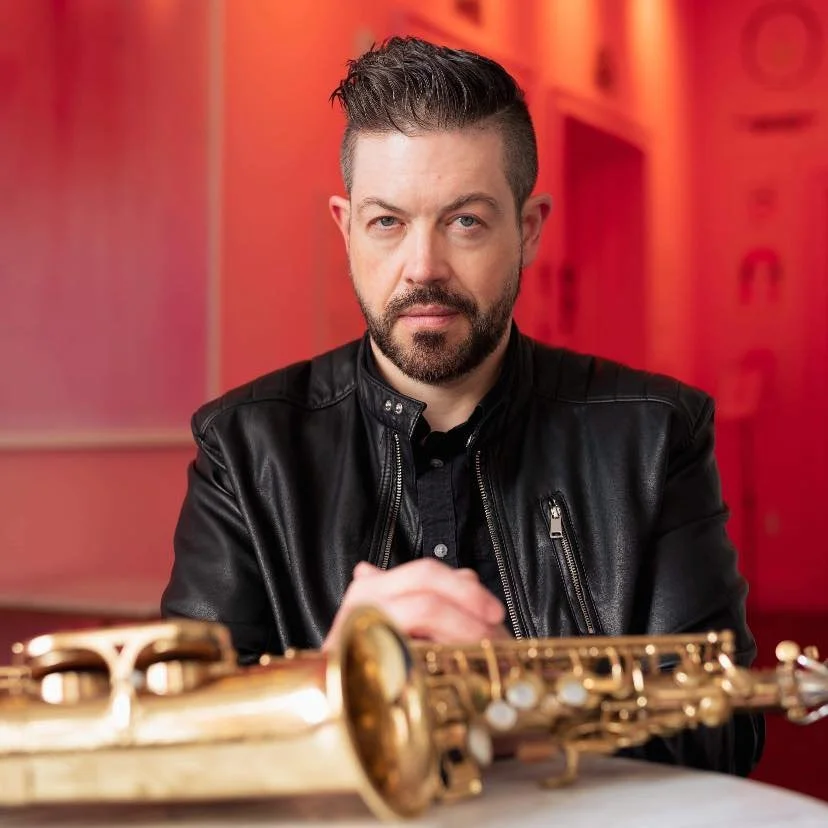
From the live release of Firecracker, Jared Sims reflects on conveying the spirit of live performance and balancing creative control with collaboration. In our conversation, Sims presents a behind-the-scenes look at his composing process and his passion for jazz. I have zero experience or knowledge of jazz, so this interview also felt like the kind of masterclass those celebrities offer with a $15 a month subscription, except it was free.
Life on Jupiter sat down with Sims to discuss Firecracker and more. Read the full interview below.
✮ ⋆ ˚。𖦹 ⋆。°✩✮ ⋆ ˚。𖦹 ⋆。°✩✮ ⋆ ˚。𖦹 ⋆。°✩
LIFE ON JUPITER: You recently released a live edition of Firecracker. My favorite song is “Echo” from your tracklist. Why did you decide to record a live version of this album?
JARED SIMS: In the studio, nobody knows that the band can go straight into tracking without a lot of overdubs. That band has a lot of magic; the guys play really well. This is music meant to be experienced live, but the live record is meant to be on a grander scale. It’s meant to be hypnotic; we captured it that way live, too, because a live performance has energy you don’t get in the studio. It also sounded good sonically; a friend came by, brought his computer, and we worked with him, his gear, and what we had in the club. So when I heard it back, I was like, “Wow, it’s really good!” I was thrilled that it took three weeks, from recording to release. It was really quick.
So last year, the Boston Music Awards named you Jazz Artist Of The Year, and you were recently featured in Rolling Stone. What do these wins and moments mean to you?
SIMS: Music isn’t about winning, but it affirms that I’m on the right path. It also means knowing people are hearing what I’m doing, which is nice. For what I do, my audience is relatively small compared to people who play stadiums. As for wins, I’ve never won anything before, so it felt strange; honestly, it was shocking. I was just nominated for New England’s Music Awards. To me, a lot of it is that my music is heading in the right direction. I don’t do this alone; I bring together about 20 musicians who play the music I write on various projects. I’m really thankful for the people I have around me and their talents; they’re so easy to work with. The credits aren’t just for me; they’re for everyone I’ve worked with, too.
You recently performed at The Beehive, one of my favorite jazz bars to go to on the weekend. It’s a popular Southie bar and restaurant known for its live jazz. What was it like to perform at The Beehive?
SIMS: It can be a really nice room to play because people actually want to come there, as you said. There are a whole lot of venues where people will say, “Oh, I don’t know. I’ll sit this one out.” I actually had some family come down there recently, distant relatives I don’t see often. I knew that was the spot that they should come to. I’m pretty indebted to that place because they give me a lot of opportunities to play, and that’s really important to me. We actually recorded the live version of Firecracker at The Beehive.
No way! I love it so much when they project the movies; I love the aesthetic and everything. Whoever’s in charge of keeping The Beehive going is a genius. Is there anything in your creative process that is important to starting a music project?
SIMS: There are infinite possibilities for sounds and ways to do things. There are endless chords and melodies. I come up with parameters, and those parameters could be for a song, a project, or a set of music; that’s one way I approach it. What I learned from Duke Ellington, I wish I’d known him, is that he wrote for specific people, and that means a lot to me. If I play with a certain musician, I’ll write something that allows them to do a certain thing. I’ll take this tune because it plays to the band’s strengths.
What are your music muses and inspirations?
SIMS: A year and a half ago, I went to Morocco. I was at a festival with about 40,000 people, and I heard Arabic jazz, which opened my mind in a lot of ways. One of my favorite performers was Dhafer Youssef, who played not a guitar but an oud, an instrument specific to that region. It was meditative, which I found really interesting, and then it would build into massive crescendos. I’m absolutely enamored with Latin music – specifically Cuban styles, anything in that diaspora. I have a new album that’s coming out in January, but I’m afraid to call it Latin jazz.
Give me three words to describe the album coming out in January next year.
SIMS: It’s very energetic, compositional and really varied. Some tracks are up-tempo; a few are more reflective. I play alto flute and baritone saxophone throughout, and I’m pretty excited about it.
What’s your advice to aspiring jazz artists?
SIMS: I don’t give career advice; I do give artistic advice. Aspiring jazz artists will want to spend time keeping one foot in the tradition and one foot in what’s next. The tough thing for young musicians is that many music schools are designed to create a musician who will be highly successful in 1958. But that has already happened; many aspiring musicians hear someone like MonoNeon or Thundercat. They hear all these musicians and think that’s the only way, but those musicians are coming out of the tradition. If you wrote something on a chalkboard and erased it, but you could still kinda see it there and then write something else; but it’s still a part of it. I think all of us who are deeply in the music scene still reference Charlie Parker or John Coltrane. I record on Saturday, and all the songs are five minutes long, which is really short.
Is that a negative thing, like will people judge you if a song is under a certain length?
SIMS: It’s hard for jazz musicians to say what we wanna say in a few minutes. The reality is jazz is still trying to get radio play, but in major cities like LA, San Francisco, Boston, or New York, it still gets radio play. So if we want a shot at getting radio play, everything has to be under six minutes. If you look at John Coltrane’s Blue Train album, it has only a few tracks, and they’re extremely long, which is really typical of jazz.
That’s really interesting. Also, I like how you use the chalkboard as an example. What song would you recommend from Firecracker for someone who’s never listened to jazz before?
SIMS: “Cobra” because it’s upbeat; it has a specific drum part, and the solos are really descriptive. I know a lot of young people who gravitate towards that track.
How does your composing process start, like when you have an idea? I know you brought that up earlier. Is it more like you have a dream and you realize, “Oh my god, I have to write this down”?
SIMS: It’s been like that before, like driving down the highway and singing into my phone’s voice app. That does happen quite a bit. My first instrument is the piano; I started playing when I was about four years old. So I learned about musical notation before the alphabet, which is kind of atypical. Much of my process happens at the piano: I set up a digital audio workstation, play, add a drum beat, and that’s really it. I have so many ideas I know I’ll forget, so I record them and listen the next day.
I do the same thing: if I have an idea, I’ll use the voice memos app and say, “Character that has this personality,” and then, let’s say I hear something from a friend, and I’ll quote whatever they said and then go on Pinterest and build my concept from there. Literally half of my voice memos are writing ideas I wanna develop in 20 years from now.
SIMS: Since you’re a creative writer, what makes what I do so similar is that you’ll write better if you write every day, and for you that could be journaling. For me, it’s the same: the best material comes when I’m constantly in that zone. So I’ve trained myself to be more open to an actual revision process rather than saying “This is the song and it’s going to stay that way forever.” I’ve learned a lot through that.
Yup, I’m the same way; even for a research paper, I’ll write for 10 minutes, shut my computer, then come back to it, and I’m pretty sure I have twenty drafts of one research paper alone. Like a few days ago, I wrote in my journal from 1 a.m. to 3 a.m., had an idea, couldn’t sleep, turned on my phone flashlight, and kept writing nonstop.
SIMS: Yeah, that all sounds familiar. The only thing that changes with music is that I put it in a band’s hands and sometimes they give me suggestions that can be really helpful.
Do you contribute their opinions to any of the songs?
SIMS: Yeah, there was a note that somebody asked to change, and she was like, “The next-to-last note before the solo section,” and I was like, “Yeah, of course!” I had the band record something in the studio the other day, and the drummer asked, “Can we add one more bar after this?” and I said, “You know what, that makes a lot of sense.” So we did it. I’m not going to try and be a micromanager; that was classic Beethoven. There was a story: he wrote something for an orchestra, and the string player said, “My hands can’t play this,” and Beethoven is like, “Do you think I was caring about your little fingers when I wrote this?”
That’s hilarious; that makes me think of Whiplash. My final question is: if you were in a record store and could only choose one vinyl to buy, what would it be?
SIMS: I would say it would be a Miles Davis record because he made some really great ones. His more psychedelic albums would be good, or On the Corner, but I’d choose Filles de Kilimanjaro. It’s a really cool record. “Frelon brun” is a tune that’s on there; Ron Carter on electric bass. The album has a vibe. You should put that record on, in a dark room, and just take it in.
That’s a good recommendation; I’ll definitely buy that Miles Davis record. Again, thank you so much for taking the time to do this interview and answer all these questions. I’m going to keep an eye out if you perform at The Beehive again.