Q&A: Cherry Blonde Reflects on Debut Album and New Solo Career
WRITTEN BY AMRITA KUMAR
✮ ⋆ ˚。𖦹 ⋆。°✩
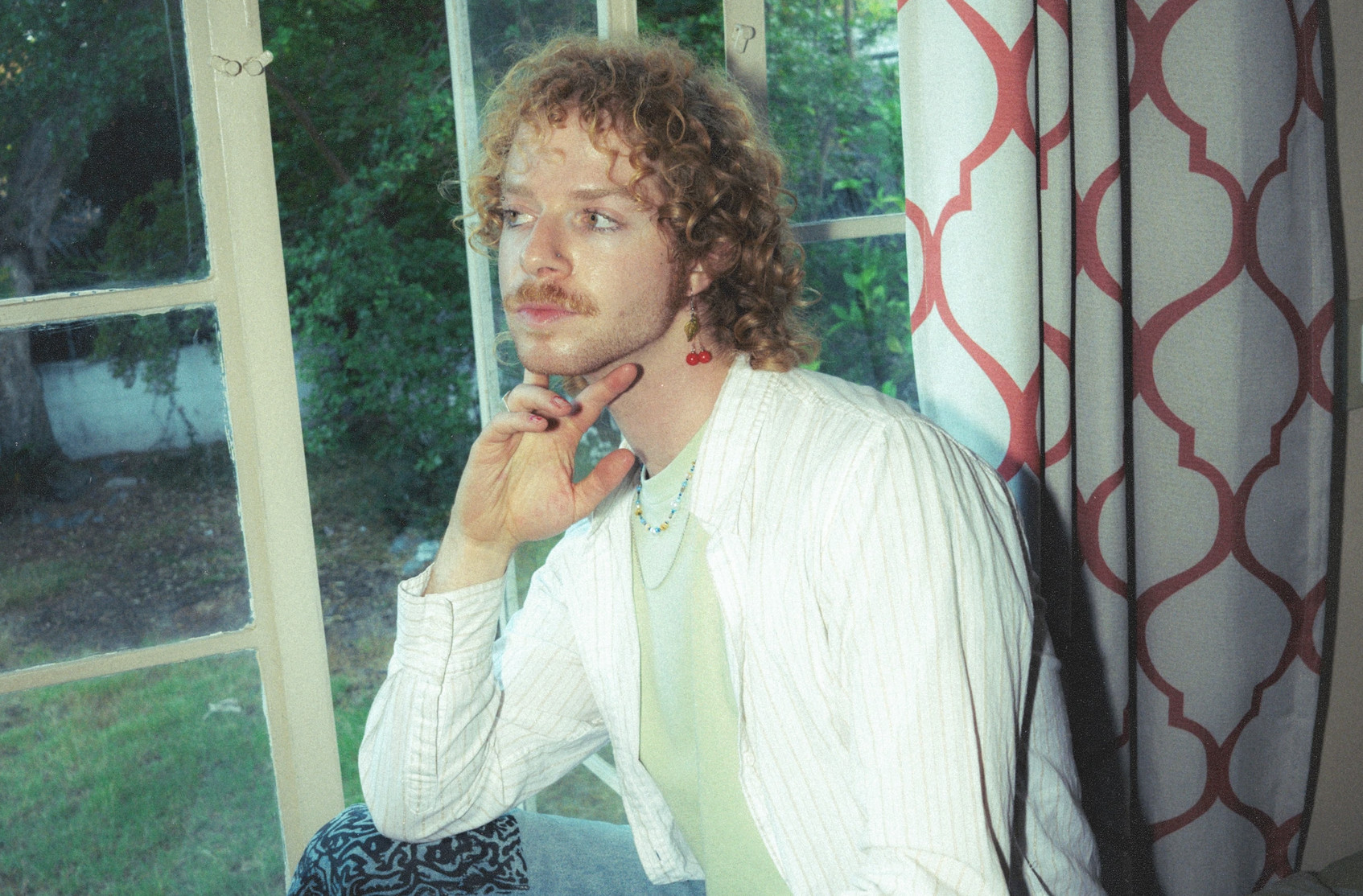
With his debut album picnic, Los Angeles-based artist Ari Eisenburg, musically known as Cherry Blonde, steps into an emotionally vulnerable and sonically vibrant era. Blending indie alternative with touches of funk, jazz, and alt-rock, he crafts upbeat songs that invite listeners to dance even though the lyrics explore heartbreak, modern dating, and the complex feelings that come with growing up and moving on.
In conversation with Life on Jupiter, Cherry Blonde opens up about the origins of his name and aesthetic, the inspiration behind picnic, and what he hopes listeners will carry with them after listening to the project.
LIFE ON JUPITER: I love your artist name, Cherry Blonde. Wondering where did that come from?
EISENBURG: Well, I grew up blonde, and the rest of my family is brunette. I don't know what happened. I feel like a lot of times people thought I was ginger, and I think realistically, I'm strawberry blonde. So I think it's kind of a play off of that. It's close to strawberry blonde, but it's cherry. When I thought of the name, I just felt like it matched my aesthetic and the music that I was making. So I don't have, like, a crazy story, but I just feel like it matches my whole energy and the music.
The first thing I noticed about you was how expressive you are, whether that's in your fashion or the visuals behind your music or the music itself. It’s expressive, authentic, and colorful. Was that an intentional choice that you made going into this project?
EISENBURG: Honestly, I just think that's who I am. And it is intentional. I like colors. I feel like recently I've been trying to be more Brooklyn and wear more blacks and whites, but I can’t help expressing myself. I love colors, and I am a very emotional person, too. Even within my voice, I like to express myself and kind of figure out different ways to use my voice. I feel like even within the album picnic, I feel like there's just a lot of different kinds of sounds on it. Within colors, too, I like to play with all the different colors and shades.
For anyone who hasn't heard your music yet, how would you describe your sound to them?
EISENBURG: I'd say it's perfect picnic-listening music. It's indie-alternative with a little bit of funk and jazz thrown in there. I like making upbeat songs that are emotional. I feel like those are some of my favorite songs. Definitely a lot of heartbreak and love songs thrown in there, too, just about my own life. I feel like this album definitely touched on a lot of relationship things and just being in LA and dating and that whole vibe.
Was there a moment that inspired this project? And follow-up question, what does it represent to you as an artist?
EISENBURG: I think the concept for me was to have music that you can listen to at a picnic. I mean, the name kind of came a bit later. I feel like I've been so focused on releasing singles leading into EPs, and that's the whole grind that I feel like a lot of people are on. But all of my favorite artists and bands release albums. I feel like a lot of times as an artist, you're like, “Oh, I have to wait until I have all this hype to release an album.” I just felt like I wanted to work on something bigger than myself. So I just started to figure out the sound of this album, and kind of going a more alt-rock route, while also still having some ballads in there. And having the theme of love and dating. I've definitely gone on a couple of picnic dates. There are a lot of different vibes in the album. Like I have a funk song, and then there's some alt-rock stuff and some more retro rock things. It's not just like one thing. I feel like at a picnic, you kind of bring all these different flavors and things to the table.
Were there any specific artists or other genres that inspired it?
EISENBURG: Yeah, for sure. I mean, recently, I've been really into MJ Lenderman. I know they've really been blowing up, but Geese. I’ve been listening to them for like, two and a half years. I also really love David Bowie. He's been a big inspo for me. Same with Prince and old Coldplay. I love Still Woozy. I don't listen to him as much anymore, but he's always been a big inspiration when it comes to indie. And Remi Wolf, I love. She just makes really fun, funky songs, and the production is always so big and grandiose. Those are definitely some of my inspirations.
I definitely see that. How is this body of work different from your EP, and how does it represent how you've grown as an artist?
EISENBURG: Yeah, I feel like my EP FREAKFUNK, I was really just having fun and doing something a bit different. Those songs were pretty lighthearted, and I feel like a lot of the lyrics were pretty funny and weird. It's not to say that this album doesn't have funny and weird lyrics, but for the most part, it's more emotional songs that mean a lot to me and that I've been working on for a long time. I feel like I really put my heart and soul into this, just kind of talking about the issues with modern dating and just having so many options. If you ever use a dating app, it can get a bit confusing. I think for this album, I was trying to go for just writing real songs that are a little bit more traditional. Using real instruments, too, was really important to me. Everything was pretty much recorded live, and for the most part, live drums. I really love the live energy, and I love performing live. I wanted to create something that would translate to that.
Was that a challenge? You were going into this project with the intention of being a little bit more vulnerable, a little bit more emotional. Was that something that was particularly challenging for you?
EISENBURG: I think with certain songs, for sure. I've still been dealing with a breakup that I had almost two years ago now. Dealing with those emotions, it's like I want to move on from that. I feel like I have, but it's also those emotions that still kind of get brought back up. Certain songs, when I listen back to them, just bring up memories. That can definitely be difficult. You have to perform those songs forever. It always makes you remember things about your past. I think it's a beautiful thing, too, but it can definitely be difficult as well.
Is it sort of cathartic to write vulnerable music that is upbeat?
EISENBURG: Yeah, what it comes down to for me is I really love to dance. When I perform live, I like to get people moving. If I can make music that just brings people out of whatever's going on back home and or just what happened throughout the work week, and just kind of let loose. I really love it. At the same time, I think that I have been trying to also make music that people can just listen to and, like, listen to the lyrics. I've always gravitated towards songs that are really fun and happy, but the vocalist is spilling their heart and guts into the lyrics. I feel like the classic example is "Mr. Brightside" by The Killers. It’s so heavy and deep, but it's so fun. I love that type of music, and I feel like I strive to make that a lot of times.
I know you mentioned that you want to make music for people where they can just kind of forget about things for a while and have fun and feel free. But is there anything that you hope listeners take away from picnic, specifically?
EISENBURG: I think that's a great question. Yeah, I want them to take away the fact that love is worth it. It’s worth it to dig deep and to really commit to someone, even though it can be easy to want to run away from your feelings. That's definitely something that I would want them to take away from it.
The first single you released from this album was “superglue.” At that time, did you know that you were making an album?
EISENBURG: Yeah, I think I decided I wanted to make an album. Around that time, I had a couple songs, “dirty sink” and “see u never,” that are coming out on the album that I had written. “dirty sink” was before I moved to LA, and “see u never” as well. One of the first sessions I did in LA, I wrote those songs, and for whatever reason, I just never released those as singles, even though I really love them. I think part of the album creation, too, was that I had all these songs that I really loved, that I felt maybe weren't as poppy, that I thought were a bit weirder and cooler in my opinion. I feel like people told me, like, “Oh, maybe this would be good on an album.” After releasing “superglue,” I felt like, “Okay, I want to work on a bigger project, and kind of create glue between all these songs.” There were a lot of differences between them. And I was like, “How do I make this cohesive and tell the story?” I feel like I did come up with the concept- and especially in the production and mixing process, I feel like I was trying to make it all more cohesive by working with the same person on mixing and mastering, and I feel like that helped glue it all together.
How did you end up deciding on the order of these tracks? Was there a storyline that you were trying to follow, or an emotional arc that you were trying to follow?
EISENBURG: Yeah, absolutely. I was also thinking about performing it live, but overall, I think the flow energetically just kind of made sense to me. I mean, I would be switching them around, figuring out what felt good one after another. I think a big thing for me, too, is not putting all the same songs that are similar all together, because I had two songs that were in 6/8, and even “superglue” kind of has a shuffle 6/8 feeling in the verse. So I wanted to separate those songs. Then there were some songs that were a bit more high-energy, and I wanted to throw those together. But yeah, I think I was thinking about energy more than anything, rather than necessarily a storyline. It did end up working out, because I’m ending the album with “superglue.” I feel like it's very uplifting, like, “Where do we go from here? What's next?” That's kind of how I feel about it. I start the album with “I want it to love u,” which is kind of introducing the idea of trying to have a relationship with someone, and it just ends up being something that can't last. You wanted to give your all to this person, but they just weren't ready for that. I think that's definitely the theme of the album. And so starting with that song felt really right.
How long was the process? I know you mentioned that you had a couple songs already ready to go. But what was the overall process like?
EISENBURG: It's been pretty much since January that I have worked on this project. Compared to other projects that I've been a part of in the past, I feel like I really tried to do this as fast as I could. I was trying not to overthink it too much, which I often do as an artist, and being like, “Oh, could we add more?” I just wanted to move on and not linger on things for too long. I finished the album in summer, and then was working on the mixes, so it came out pretty fast, which was really nice.
Did you feel any pressure? And how do you deal with moments like that, where you feel like something has to be really perfect?
EISENBURG: It's really difficult, because I feel like there's a fine line with art. You can spend years on a project, which sometimes is worth it, but other times it's good to be putting out music consistently. I feel like that's the pressure that I feel. It's good to keep feeding the algorithm and releasing music on Spotify, but I really tried to give myself time and make sure I was really happy with each production and with all of the mixes before starting the first single, which is something I hadn't done before. A lot of music videos were finished, and so I wasn't scrambling to finish all the components. With FREAKFUNK, I felt like that whole rollout was kind of rushed for me. It was really stressful to try to film the visual and edit it all a couple of weeks before. I think that pressure can feel really nice, but it's also nice to be able to allow other creators time to cook and allow me to sit on something. I think there is a fine line between both, and especially as someone who doesn't have a big following or that many fans, I feel like it's important to be more consistent. I feel like when you become a bigger artist with a ton of fans, you don't really have to release music as often, because they already have people listening. But yeah, it’s a difficult dilemma. As an artist, I feel like I do a pretty good job of just letting things go and not holding on to them forever. But part of me sometimes is like, “I really want to just give myself as much time as I need.”
Was there a song on the album that almost didn't make the cut, or a song that you decided at the last minute was going to be on the album?
EISENBURG: I don't know. I feel like I was pretty sure of every song. I mean, there’s definitely a lot of songs that didn't make the cut. I thought I was gonna have 10 songs maybe, or 11 songs, but it ended up being nine songs. “dreaming of a rush,” that's a song that I've also been sitting on for a long time, that I actually created with one of my friends in San Luis Obispo, when I was living with him. That was a song that I wanted to release for a long time, and so I wasn't sure if it felt good on the album. It almost felt like more of my era of frequent funk and an R&B kind of beat. But I'm really happy that I'm releasing that one.
Is there a favorite song that you have on the record?
EISENBURG: Ooh, that's really difficult. I like all the songs for different reasons, but I think one of my favorite songs is definitely “dirty sink.” I produced that one for the most part by myself. I think it's kind of dark and weird, but I really like the chord progression, and I also really like “eat ur heart out.” It's kind of like a '90s throwback. I've just been getting more into grunge and making weirder stuff, because I feel like I end up writing kind pop songs with normal chords. Those are the singles that are gonna reach the most people. But sometimes my favorite songs are weirder songs that have more edge to them.
What was your experience with music growing up? What was your music origin story, and how did that translate to wanting to make music later in life?
EISENBURG: I've been doing music. I grew up playing violin when I was like three, and I did Suzuki. That's all ear training. I feel like I've always had music in my head, and I just want to let it out. I played violin for many years, and I always really liked singing, but I definitely wasn't that good a singer. Both my parents aren't vocalists. I first started getting into performing when I got cast in Frog and Toad when I was in second grade. I was Toad, so I was the lead role, and I was so stoked. I definitely wasn't that good at singing, but it was kind of perfect, because Toad croaks more than he sings. After that moment, I knew I wanted to keep performing. My favorite part of music is performing live. And I love recording. I love writing, but more than anything, I love being up on stage and bringing people together and having fun and connecting with people in that way. And so after that, I picked up the ukulele. I went to a ukulele festival with my dad, and he bought me one of those blue ukuleles with a dolphin on it. Also, this was before "Riptide." I started writing songs on the ukulele. Then my dad brought me together with one of his friends' kids, Anthony, who played guitar. And then we started gigging around the Bay Area when I was in middle school. Anthony had a band, an alt-rock band, and I ended up joining that.
That was my first time having a band, and we were very alt-rock and grunge and a little bit emo. It's kind of my guilty pleasure to make emo, alt-rock type music. After that, the band fizzled out. They were all a year or two older than me. So, my senior year of high school, I really started to learn how to produce. That's when Lil’ Peep was big, and XXXTENTACION and Juice WRLD. I was very inspired by hip hop meets emo music, and so I made an album that was a bit more hip hop, alt-rock kind of vibes. That was cool. I was kind of doing the hip hop thing for a while. But then I was like,” You know what? This is not the vibe for me.” I wanted to make a jazz band. I really was inspired by Frank Sinatra and old music like that. In my sophomore year at Cal Poly, I ended up bringing together a bunch of jazz musicians. And that's when Honeyboys started, and we made funk music and jazz, and that was something I'd never really done before. And I feel like they really helped me grow, because they were all such incredible musicians. That pretty much led me to Cherry Blonde after college. It was hard. I really loved Honeyboys, and we performed a lot around California and played some festivals, but they all wanted to be engineers, which is super understandable. But that led me to Cherry Blonde, which has kind of been a solo project, but it's still a band. I still love performing live with the band, and I want to keep that going forever.
Was that an adjustment going from playing in bands to doing something solo?
EISENBURG: Yeah, absolutely. It was pretty scary. It was like going through a breakup with the band. It was like I was in a committed relationship with them, because for me, Honeyboys was everything, and I was putting all my time and energy into that. So yeah, it was scary. But it's also been really freeing to be able to work with any producer that I want, and it's a lot easier to manage filming a music video and not having to coordinate everyone's schedule. I feel like the thing that's been a little bit more difficult is playing shows as a solo artist. I’m lucky, because my roommate is part of my band, and I have a couple of other friends, but everyone needs to be paid, and it needs to be a show that's worth it for us to do. Whereas with the band, we would just play shows all the time, and have a band when we were in college. I think that part of it has been a transition, and it just puts a little bit more pressure on me to be selling tickets and to make it even more professional. I've really been enjoying having this project. For a long time with Honeyboys, I really liked that it wasn't about me. It was about the music and about the band, and I still kind of feel that way. I think it's important to have a project with an artist identity and someone leading it. I love putting myself out there and expressing myself, and so I think it's been really good.
Now, with the release of your album, what's next for you as Cherry Blonde?
EISENBURG: I might have a surprise drop around Christmas, like a little cover. I want to release more music at the beginning of the year. I already have a couple planned. I've been working on new music, and I want to perform more, too. I feel like this year, I've really been hunkering down and working on this record and not playing shows as much. I have a couple of shows coming up, but I would love to be playing more in January, February. And I think a goal for me, too, is to be able to go on tour.