Q&A: Crafting Moments With bleakhaven
WRITTEN BY MAKENZIE TAFRALIAN
✮ ⋆ ˚。𖦹 ⋆。°✩
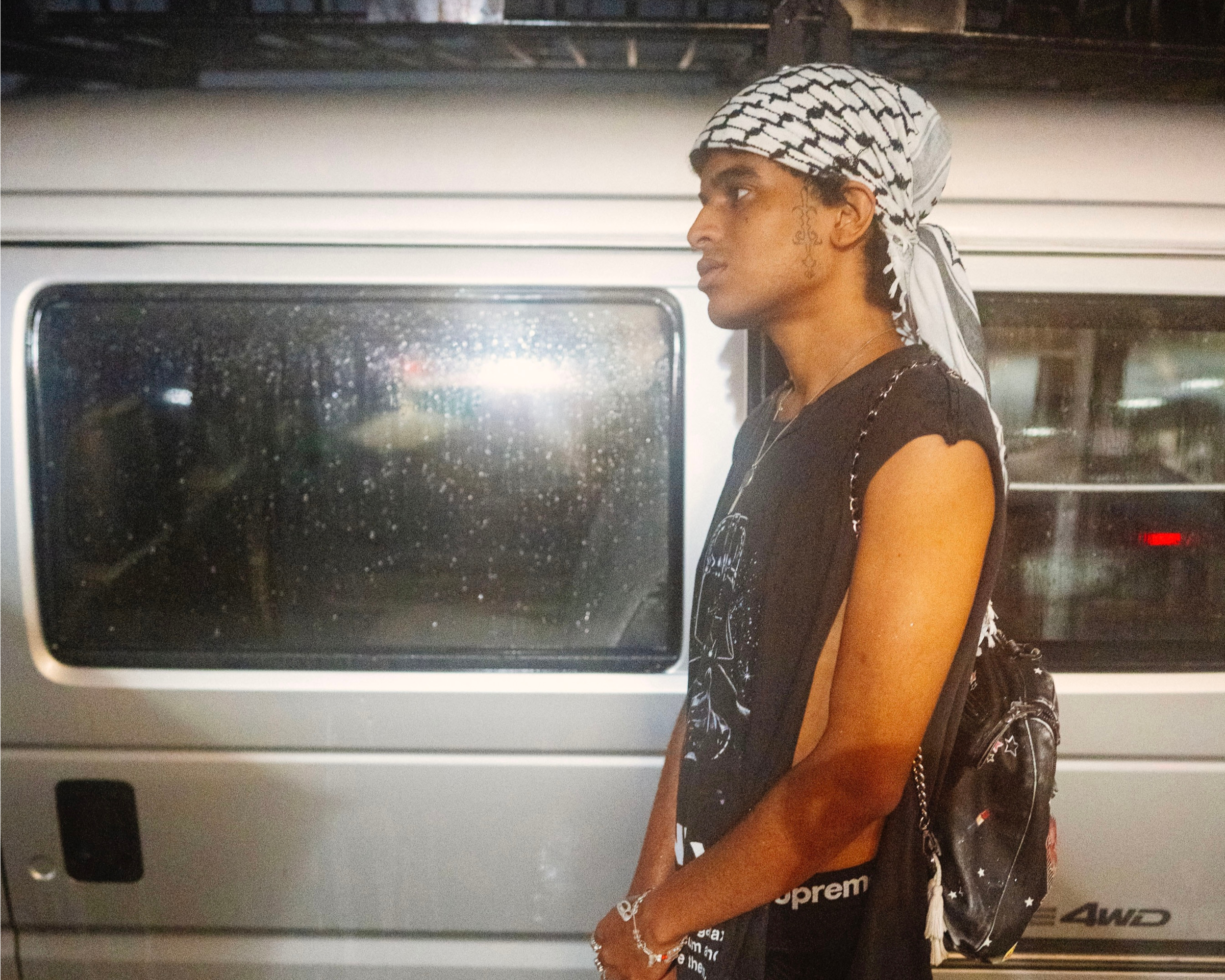
Photo by Sean Swann
Claiming the title as a new kind of techno artist, bleakhaven is making music for a completely unique vein of taste in electronic dance. Releasing music since just after the pandemic, it was evidently her own inner world collapsing that brought bleakhaven to techno.
A multi-faceted artist in her own right, bleakhaven has a throughline to her artistry, connecting aspects of her creation, process and music to philosophic theory, literature, film and beyond. What she describes as an “overarching process” provides layers of depth, introspection and self-awareness that can often be missing from the genre at large. What bleakhaven strives to create is a meeting place where timeless and energetic techno collides with the explosive and unforgettable moments integral to those of rap and hip hop music.
We had the pleasure of sitting down with bleakhaven to chat about her music, how she got her start in the underground, and where she plans to go next. Available for booking in the New York/Brooklyn area, bleakhaven is the freshest and boldest face of East Coast techno music.
✮ ⋆ ˚。𖦹 ⋆。°✩✮ ⋆ ˚。𖦹 ⋆。°✩✮ ⋆ ˚。𖦹 ⋆。°✩
LIFE ON JUPITER: How did making techno music start for you? Run me through some of your major influences and inspirations and how bleakhaven came to be.
BLEAKHAVEN: I’ll start with how bleakhaven came to be. I grew up in a cult - my dad is a relatively globally influential Jehovah's witness in terms of their own network. Obviously, that provided a lot of issues for me as I got older, as I am trans and a lesbian. There was a moment when I was in high school, when I got into a physical altercation with my dad and he kicked me out of the house. Fast forward to when I was living with my grandma, I had written a suicide note titled “bleakhaven.” That turned into the original mantra for my artistry - “The safest places face an absence of life, find your space to create, find your place to be great.” For me, I felt I hadn’t unlocked a lot of the creative potential I had until I was in that moment writing the suicide note and having these realizations about myself.
Then, in 2020, four years later, I rebranded. I didn’t want a long, convoluted mission statement. I wanted to have one line that encapsulated what I was doing. I changed the mission statement to “experiential design…” I don’t separate my fashion, my philosophy or my approach to music from bleakhaven. These areas encapsulate the same thing for me. The process of designing my life is what I do and my influences for that are postmodern French philosophers, primarily Jean Baudrillard. Through my reading of his works, I found foundations for what “experiential design…” really means. Since then, bleakhaven is what I call my label of artistry, because at this point, it is it’s own thing that is separate from me as Skyler in that it represents more than just my face.
Techno music came into the picture in relation to my experience living in a cult. I was so isolated by a lot of the rules and thus being forced into isolation, further forcing me into being a child of the internet. One of my first YouTube rabbit holes was this thing called QDance, a hub for Dutch hard dance in Europe. I’d say from around age twelve I was watching aftermovies of festivals and various DJ sets online. I play so much of my own music and so much of what bleakhaven is is an overarching process. As a twelve-year-old watching these aftermovies, I may have downloaded a song I like and thought, “one day I’m going to play this live.” That thought doesn’t really leave my mind.
That’s how I think of my influences; I feel attracted to things that are timeless. I include these things in my sets because they are timeless. I find a lot of music influence from movie soundtracks, because so much of it is based on feelings. Further, I’m greatly influenced by the kind of engagement with vocal music seen in alternative and rap spaces. There is so much missing in artists’ articulating or creating a feeling for the audience being a part of the creative process.
In my mind, I see a Playboi Carti performance at Rolling Loud and there’s a moshpit and everyone’s going crazy and losing their mind - I want to replicate that with techno. Which obviously will look different, my music has less lyrical content and other contributing factors, but I feel you lose your ability to blend that when genres are so hyperspecified - “oh this is groove, this is hard.” I am trying to create moments. I am trying to create moments that people remember, and that people can comparatively say is unlike any other moment. Or even creating moments for those who don’t know they can get the same feeling, energy and vibes of something like Carti from a set like mine. I am really creating a space in techno for vibes and cultural paradigms similar to those of 2015-2017 Soundcloud rap.
How do you feel your involvement in your community and overall environment impacts your art directly? Are the two hand in hand for you, or does your environment simply backdrop what you’re exploring in your art?
BLEAKHAVEN: I think the environment is a backdrop for the reception of the art. When it comes to the music community, the keeping up appearances parts of music is the worst part for me. With all due respect, I do not want to go out and meet at 4am at an afterparty and that’s where we talk about music or setting up a show or what have you. The networking game in the underground is so stupid. I think the way the music is directly affected by community is in the comfort and identity aspect of it. For example, so much of the authenticity of my music in the current day comes from both ideological influence as well as radical affirmation of self, in regard me being trans, black, a woman. I would not have been able to engage in that radical affirmation of myself and who I am on that level of discovery without the trans community writ large in New York. Whether that’s providing access to resources and my medical providers, it would not have been possible without the community I have here. Though that is very separate from my musical output.
I think bad community is horrible and I think good community is necessary but you can’t simply wield into existence good community. I think the meaning of community comes down to finding the people who see you for you over time. I have my Brooklyn community, my online community. Everyone needs some network on the creative level, but specifically on the level of self-actualization for support. Especially being trans, I feel like there is a huge part of that where it becomes way less painful after you have your initial realization of “Oh, I’m not abnormal.” It is very, very important for a trans person to have any kind of forward-facing relevance or power in music and also creates the path for letting them know it’s possible.
Where do you find the music’s origin in you? Does a song start as a melodic idea in your head? Or is it more organic than that? Do you find you’re more often just exploring and you land on something you want to keep? Speak on your process a bit.
BLEAKHAVEN: My live experimentation is very dependent on the moment, which I think will grow and change and evolve. As far as where the music comes from, it’s one of two ways. Either something has happened that puts me in a certain mood where all of a sudden, I am able to convey these emotions into art. The other way, more so organic creativity. This looks like hearing a melody in my head and opening up Logic and writing it down. I do have a classical music background; I was a trumpet player. Because of that, I have always been a proponent of producing your own music. Production is such an idea-based thing and something as simple as a voice note can be turned into a very real final product.
Music is such a transformative thing that can really affect people which is what gets me inspired. I feel very secure in my feelings about music, which comes from there being so much that goes into not just making music for me, but how I’ve arrived at my perspective on music and what it means to me, what its purpose is, what it can be and all of these things. I find it very difficult to make meaningful connections based on music if someone doesn’t see eye to eye with me on that level, which is a huge thing in techno, especially, with all the fake underground rigamarole, which means nothing. There should be genuine utility that can contribute to the overall growth of this vision that has been with me since I was sixteen. When it comes to where everything is being pulled from, it’s like a fiery passion and desire that lives in me all the time.
You use limited lyrical content, and your most recent project has significantly a lot more than you used to use. Can you speak to the development of that in your music?
BLEAKHAVEN: I haven’t really thought about this myself until now. I think that started in my search for moments, as we’ve been talking about, but part of it was my inability to record my own vocals. All the music I have out featuring my own voice was recorded with the help of a friend, so I haven’t had free rein to add vocal texture. Mostly, though, it was the search for moments. In making Parental Control, I was listening to a lot of Shania Twain and Stevie Nicks. Basically, I was just looking for stuff to sample from them and I landed on this 1990s interview of Twain I used, which has such specific imagery to me.
The usage of vocals is also organic in the sense that an idea comes up, such as one for a mutual friend to send me vocals as a voice memo and it ended up being perfect. I do think my tried-and-true club-type music will always have less vocal samples, but the upcoming album will have full vocal songs, more like a dance album. I really enjoy using my voice and I think now that I’ll have my own ability to record with my own equipment, I’ll be able to start experimenting with using my voice as an instrument more. I am really excited for that.
What’s next for bleakhaven?
BLEAKHAVEN: Honestly, right now I wanna tour. I want to play the music I already have out in different places. There’s so much of my music that is one, good, and two, new to so many people. While I work on music in some capacity pretty much every day, I am getting to the point where I like my sets to be half to three quarters my own music while throwing in the songs in-progress at that current moment. I’m having some anxiety about which of my songs to put in sets these days because there are so many of them. I really want to play with what I already have and really make the most of that. Ideally, before I’m finished with my next album, for inspiration purposes and because the next project is really different sonically.
I also want to take things international. The scene in New York when I first started to navigate it in 2022 was not very kind to me and still isn’t really today. Immediately when I felt that energy, I thought to start reaching out to people in Europe. That’s how I debuted my first few projects on Rins France; that’s why a lot of my connections are overseas. I only recently started getting locked in with people here. I’ve been way more tapped in in Berlin, France, Amsterdam and London than I ever have been here. I want things to be facilitated properly so I can get my work out to the most people. Once ears get on it I have such confidence in the reception of it. I’m only going to live in an era of being unknown once, and I stay present by appreciating a future I see for myself, wherein I can look back on this time and think, “Damn, I was so bitter… if only I knew what was to come.”