CREATOR SPOTLIGHT: Translating Music Into a Visual Medium with Cheeky Chong
WRITTEN BY ANTHONY RATCHKOV
✮ ⋆ ˚。𖦹 ⋆。°✩

Photo by Martina Arfeliz
Cheeky Chong is the pseudonym for Shirley Chong, an illustrator and designer based in Oakland, California. The incredible vibrancy of her work quickly stands out, but something that also stands out is the line at the top of her website asking, “Do you need good but kind of bad drawings?” It’s the perfect line to capture the raw characteristic her art has that makes it so captivating.
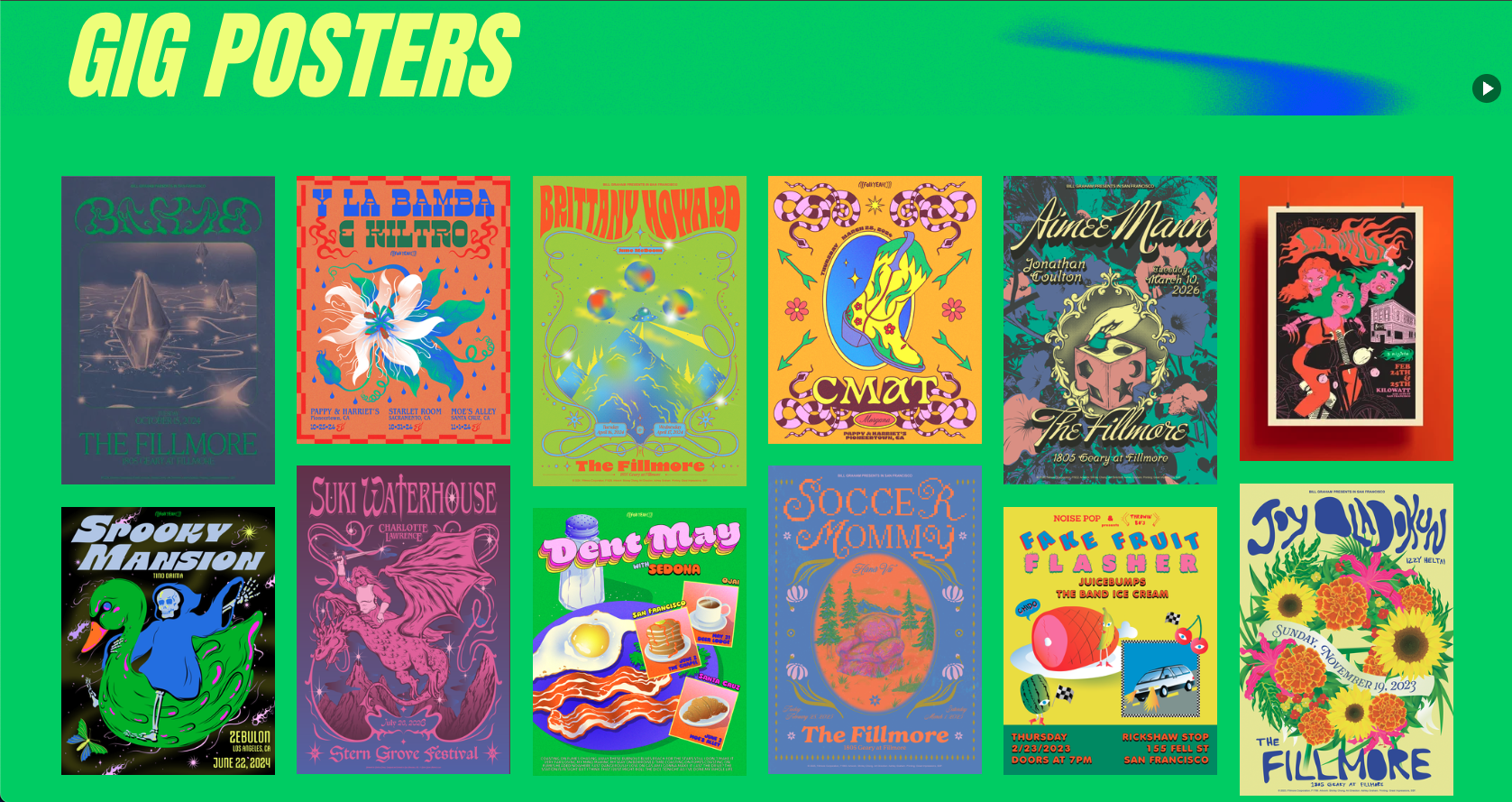
The same principle applies to our memory of a concert. We can’t hold on to a show forever. Once the music stops and the crowd disperses, the unforgettable night turns to a memory that becomes increasingly incomplete over time. All of a sudden, a concert poster we take home becomes one of our only physical, tangible ways of recalling such a special time. With some of her projects, including creating concert posters for artists like Bakar, Suki Waterhouse, and Soccer Mommy, Cheeky Chong teleports us back to the moments we never wanted to leave.
Life on Jupiter had the pleasure of sitting down with Cheeky Chong to discuss the stories in a concert poster, her unique creative process, and everything in between. Read the full discussion below.
✮ ⋆ ˚。𖦹 ⋆。°✩✮ ⋆ ˚。𖦹 ⋆。°✩✮ ⋆ ˚。𖦹 ⋆。°✩
LIFE ON JUPITER: You recently designed the poster for Suki Waterhouse’s show at Stern Grove Festival. Why was her song “Legendary” the one you based the design on?
SHIRLEY CHONG: I was just listening to her music and seeing what hit. Ultimately, that's why we’re fans of music. We find common ground. I feel like musicians make art, in part, for the other human beings who feel the same way.
I also hadn’t made anything medieval themed, and I was like, “Sick, I’m gonna put swords in this!”
The poster you made for Bakar’s show at The Fillmore also features some glistening elements. How did the visual of gems rising from the ocean capture the canon of his music?
CHONG: I was reading about the album he released at the time, Halo, and how so much of it was about lighting and brightness. This whole album, but particularly his breakout song “Hell N Back,” is about going through a hard time and coming out the other side. The poster is kind of a metaphor for that. The ocean is a deep, dark place. I have these sparkling gems ascending from the ocean just shining. That's the concept: emerging out of a dark place.
Does the variation between venues also give you different inspirations? For example, does a beautiful outdoor venue like Stern Grove tickle a different creative bone than a popular indoor venue like The Fillmore?
CHONG: Yeah, I think so. I will say a lot of other poster artists I know have their own specific style that they stick to and it’s kind of their signature, and I think that works for them, but I don’t really like operating that way. It just does not feel natural for me. I really like experimentation and feeling out what is right. My art is not central to the poster, it’s about the music and then I go by how I connect to it. I’m usually a fan of an artist’s music but I don’t know them personally. All I do is listen, read interviews, pull from lyrics to try and make something that will resonate with fans, like myself.
No matter what a songwriter composes, everybody interprets the music in their own way. While highlighting the original subjects, would you say that sometimes your posters showcase a few twists in your own interpretation?
CHONG: That’s just inherent in the process. A lot of writers don’t explain what their music is about, and I totally respect that. They want you to interpret it. We’re all living different lives and however you take in a song is up to you.
You also helped make visuals with Spotify a few years ago. Your creation “Now Checking In” revolves thematically around self-reflection, so why does the person see an alien when they look in the mirror?
CHONG: The concept of that is that an alien is foreign to you. Looking at your reflection and seeing something you don’t recognize. You’re thinking this isn’t me, or this doesn’t align with my values. You need to take a moment to reflect, “Do I need to change something right now?”
It was really cool to learn that you sketch with highlighters, and the radiance and vibrancy of your works are really reflected by that. Would you say such a bold move reflects your Oakland-like mentality about being direct and honest?
CHONG: Yeah, I think that’s a valid interpretation. I definitely like stuff that's loud. It kind of just makes you go for it. And I like that it’s transparent, so it’s nice to layer. I didn’t grow up with a lot of money, so when I have expensive art supplies, it makes me concerned that I will waste them on making something I don’t like. For sketching, I just use cheap office supplies that I don’t even know how I got, so I have more freedom to just make whatever. I feel like that’s really essential to making art, removing barriers to creativity so I stay loose with how I work.
You sometimes add motion to your pieces. What is the mindset in choosing which pieces should come to life and which pieces are already packed with a lot of action remaining still?
CHONG: Part of it is just depending on if the client wants me to, but given my taste, if there was a budget for me to add animation to everything, I probably would. If they’re printing a poster, that’s practically impossible. Usually, the way I work is that clients send me a project brief, and I come up with some concepts. If it’s something that feels right to include animation, like how sometimes we’ll start off thinking it’s going to be still and then we think it’s going to look so much cooler with animation, then we just say let’s do it. I don’t always know at the beginning of the project until we all have an idea of what direction we’re moving towards.
You’ve featured your art in many different areas, from printed design to even your own short animation. What’s an area you would love to tackle next?
CHONG: I think a lot of my personal work revels in an unapologetic, stupid sense of humor. I love all the work I’ve been able to do so far, but sometimes my silly humor doesn't fit the project and artists at hand. I would really love to work with more musicians like Viagra Boys or Amyl and the Sniffers who have a kind of core stupidity in what they do. Not that I think any of these artists are actually unintelligent; rather I have a great affinity and appreciation for how unafraid they are to subvert with humor.