Q&A: An Evening in the Desert with Abigayle Oakley
WRITTEN BY MAKENZIE TAFRALIAN
✮ ⋆ ˚。𖦹 ⋆。°✩
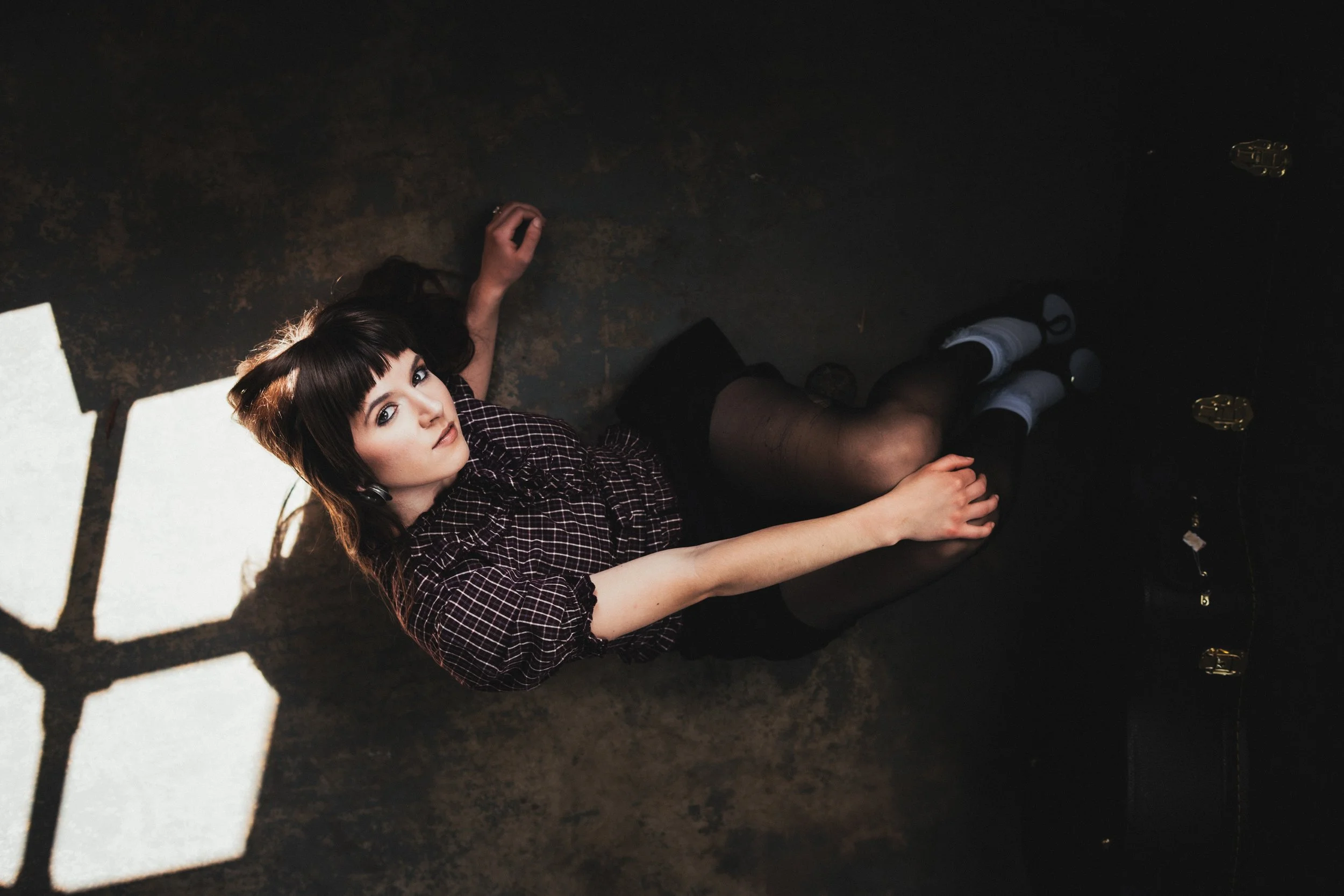
Photo by Lucy Bates
“Songwriting has brought me to the most beautiful corners of the world,” Abigayle Oakley gushes to an audience of friends, family, and fans alike on this particularly beautiful Saturday evening in April. The wind blew at the most perfect temperature as the sun set at the Dustland Bar in Las Vegas, where Abigayle Oakley and her friends, Madeline Kelson, Remi Goode, and Gabe Lehrer performed for the very first time in their tour through the desert. These fine musicians told new yet familiar stories, mingled around the dirt floor, and shared the most awe-inspiring songs.
From one entertainment-centered city to the next, Abigayle Oakley is a Nashville-based artist with roots in Las Vegas, where she has returned for a homecoming show. Oakley is here after a stunning run on NBC’s The Voice, kicking off her Blind audition with an instant triple-chair turn around and a comedic battle of “No, pick me!” from the judges.
Positioning herself as an indie rock artist, Oakley has been garnering attention following her charming disposition and equally compelling storytelling. As a friend of mine, I have had the pleasure of witnessing Oakley’s blossoming into a multifaceted artist of her own making. Following her 2023 debut album, Recovering Optimist, she has been building momentum for herself in recent months touring throughout the U.S. and Canada.
Earlier that evening, we had the pleasure of sitting down with Oakley in an interview. We spoke about how she came to write her music, what she’s been up to lately, and where she sees herself in the future.
✮ ⋆ ˚。𖦹 ⋆。°✩✮ ⋆ ˚。𖦹 ⋆。°✩✮ ⋆ ˚。𖦹 ⋆。°✩
LIFE ON JUPITER: Was songwriting always a part of your process with your guitar playing? Did you always write songs here and there or did it develop as you got older?
ABIGAYLE OAKLEY: Yeah, I’ve always loved stories and writing, and then when I went to [Las Vegas Academy of the Arts], I was just playing so much guitar, it was kind of inevitable to be writing songs. I’ve been seriously writing since I was like 16 - like, finishing songs, you know?
And then, when it was time to figure out what I wanted to do, I didn’t know anything about Nashville, but the more I looked into schools and things like that, I saw that you can actually build a career on songwriting and there’s a whole world out there for independent musicians, and that’s what Ive been doing since I graduated and have just been DIY touring here and there and making records and all the things.
How did Nashville play as the backdrop of your college experience? How did that influence you? Or was it just truly in the background of what was inevitably your idea, your plan?
OAKLEY: In Nashville, there’s so many songwriters, and people who have found varying degrees of success, so any night of the week you can go out and hear the most mindblowing song, and that’s what made me really wanna hone my craft.
Aside from them, who have been your most major influences or inspirations in terms of writing or if you can get more specific, with melodics or production?
OAKLEY: Andy Shauf. He’s a brilliant composer and producer, and I saw him play live in Nashville with his band, and he just plays every single note to a T and it was so cool. And he’s also kind of an introvert and I feel like I resonate with that, he’s shy and does what he loves, so I’m like, That’s what I’m trying to do! I’m trying to be shy!
Focusing presently on what is going on in your bubble, I was curious what inspired the choice to audition for The Voice?
OAKLEY: They had an open call in Nashville, and I’ll try anything once, you know? I just wanna learn as much as I can, so it was never on my top 10 “I need to do this,” but as it just kept progressing and I got to do the blind audition, I was just kind of like, Whatever happens, I’m still out here and I get to be doing my thing. And then, kind of the best case scenario happened, and I was on the show, and got to really just play in a new sandbox - it’s such a different world than any music experience that I’ve had, and I can’t say enough great things about it, they were really good to me when I was on there.
Do you think that experience may have a major or minor influence on the actual art you make and produce?
OAKLEY: I’ve been posting my journal entries from my time on The Voice on Substack, and it’s been a fun way to see, reading it back, how much I learned personally and professionally, too. It’s good to do scary things, and stretch yourself, and I think that’s gonna carry over into everything. I’ve already written a bunch of songs about it. That’s gonna happen no matter what I’m doing, whether it’s The Voice or hanging out at The Dustland. Get a song out of it.
I love your content - the visuals you put out to backdrop your music. I am wondering if that comes naturally to you. Do you have an idea, put up the camera and say “This is gonna be what it's gonna be,” or do you feel like all the other artists in the world now who feel like they have to make content and they have to be online and they have to be present? Where’s that balance for you?
OAKLEY: Yeah, it’s exactly a balance, and I feel differently about it every day. But if I have an idea that I’m excited about, I just think about growing up here. My brother and I would make home videos and write scripts, and film them. So, when I can make it fun and connect to a childlike joy, that’s when it’s best. But in order to be consistent, there are times when you just have to do it like any part of the job. So, yeah, I try to have fun with it, and I’m always writing down little ideas. I mostly wanna make people smile because the world can be so serious all the time, and my music is sometimes serious, so some of the lighter videos I think make it more approachable and fun.
How about your writing process, do you feel attacked by inspiration or do you need to sit down and inspire it out of you? When it comes, do you run with it? Or file it away for later and ruminate on it?
OAKLEY: It depends. Ideally, you run with it. It happens both ways. I love when it just comes. There is a book called Big Magic by Elizabeth Gilbert, it’s all about creativity, kind of inspired by The Artist’s Way by Julia Cameron, incredible. Love her. There’s some good gems in there, and one of them believes that ideas tap you on the shoulder, and if you don’t respond, they’ll go to the next person. It encourages creativity. Those ideas are always present; it’s spiritual in that way. But then sometimes, you do have to sit in the chair and write the bad idea and know that you’re not connected to whatever creative cloud. But it’s important to do both because you can’t always write something that is inspiring to you or anyone, and no one will ever hear those songs, but you wrote them anyway, and that’s the point. People need to know that there are bad songs. And it’s good to write the bad songs. It’s good to just create, create as much as you can.
Do you find there’s any one part of the process that is a super struggle or a hard point for you?
OAKLEY: There are certainly moments where all of those things can have friction, but I think that’s part of the creative process, and it is fun to kind of work out those kinks. Independent artists are small business owners, as well, so I wish I could just make art all day and be a millionaire - well, pay my bills, more. But there’s a lot that goes into booking a show like this, you gotta be savvy on the email, and you know, negotiation. It’s hard to perceive your art and then tell people about it and sell it, essentially. That’s why people have managers and agents, because they have advocates. But for right now, it’s like I’m booking tours with the help of friends, of course, crashing on people’s couches, and just trying to make it work! And, you know, it’s really fun, but it takes a lot of planning, a lot of logistics, a lot of non-creative things.
Who would you say is on your team right now? Do you have someone you sit down and write with, someone you sit and talk out melodies, talk out song structure, anything like that?
OAKLEY: Yeah, I mean, tonight my team is Remi and Madeline and Gabe, we collaborated on this show, and I have a friend, his name is Michael, he has a company called Mad Records and it’s an artist collective, basically. He provides opportunities for independent artists and is a good friend of mine, so we always talk. “Is this a good idea?” and I rely on him a lot for business ideas. But I could list names forever of people who help, because it takes a village. And I try to be helpful in return because, you know, no gatekeeping! We’re over that; it’s 2026.
I feel a lot of your writing revolves around the trials and tribulations of life, girlhood, relationships, and things of that nature - growing pains. Is there anything you feel like you can’t write about yet? Anything that feels like a hard point or you don’t have the words for? Or maybe, stuff that you write about and you just really don’t want to put that out there - you write it, but it’s for you?
OAKLEY: My first thought was motherhood, I mean, at 26, I have no words for that. It makes me excited to live more life. Someone asked me one time, “How do you have anything to write about, you’re young?” Stories are the best and most human thing that we have and that will always be what I’m trying to document. How does it feel to be 26 in this life and time?
I’ve been calling my music existential indie folk because I just have these existential crises of “What is my purpose and how do I just be? How do I get the most out of this life, being on this spinning rock, you know? And there’s no instructions.
If you were to paint a picture of the world while your music is playing, what would it look like?
OAKLEY: I’m picturing the face of an old man who has lived a beautiful life, and he’s smiling and crying a little bit at the same time. I want to remind people that the world is still a benevolent place, and it’s also really awkward and weird and terrible sometimes, and that’s kind of the line we walk as humans. Enjoying your life and it’s also really hard sometimes, and isn’t that funny and sad but mostly just - that’s life!
Any future aspirations for collaborations, collaborators? Do you have any “Wow, one day, this person.”
OAKLEY: I mean, we talked about Andy Shauf. I’d love to work with him in some way. That’s a main one. I’d love to open for any of the artists in my music library right now. I think that would be really cool.
Finally, you’ve been very present in your desire for a Tiny Desk Concert of your own. Are there any other types of venues similar to that that you’ve always wanted to or thought about playing?
OAKLEY: I can’t think of anywhere specifically, but I think my 5-year goal is to be able to sell 100 tickets in like, 20 cities, that would be my “I’ve made it.” I love an intimate show, and I mean someday, I would love to play The Ryman if they’ll have me, but right now I love getting to play in these smaller spaces because you get to meet everybody and see the immediate impact of music. I have friends all over the country just from doing this, and it’s a fun way to connect with different people of all different backgrounds, and see corners of the world I wouldn’t otherwise find myself in. I do get ahead of myself, too, but I feel ideally we are present and enjoying the process.