Q&A: A band called Guess? on Embracing Imperfections as Their Superpower
WRITTEN BY HAILEY VALDIVIA
✮ ⋆ ˚。𖦹 ⋆。°✩
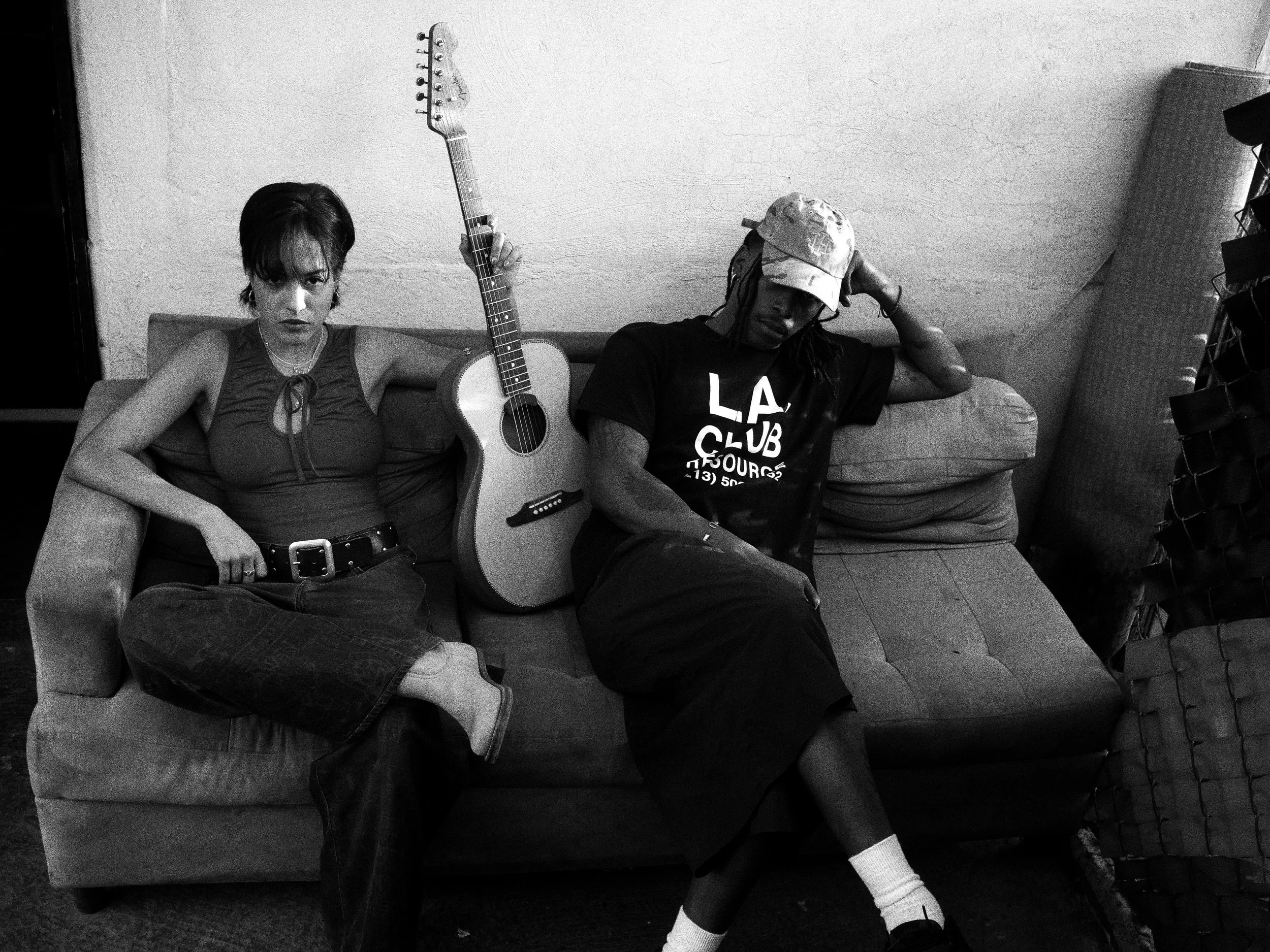
Photo by Cesar Rodriguez
A band called guess? is a Miami-based duo composed of Natalie Foucauld and Chris Cadaver. The pair came together through a shared love of music and the communal energy of live music in general. Their sound draws from a wide range of influences and experiments with blending genres of trip hop, indie and many more.
The band came out with their first single, “inside,” in October of 2025, setting the tone for their debut album that came out last month, Meeting Point. The album was built both together and apart, which became part of the music itself, creating a body of work that feels both intimate and expansive.
The two have upcoming shows in Chinatown New York on September 18 and Austin City Limits Music Festival on October 3.
Read our full conversation with Natalie Foucauld and Chris Cadaver down below.
✮ ⋆ ˚。𖦹 ⋆。°✩✮ ⋆ ˚。𖦹 ⋆。°✩✮ ⋆ ˚。𖦹 ⋆。°✩
LIFE ON JUPITER: Can you share a bit about your background, including where you are from, how you got into music, and what has influenced your sound the most?
NATALIE FOUCAULD: I grew up in South Florida in a Haitian and Puerto Rican household filled with Latin and African music, reggae, soul, jazz, classical music, and artists like Prince, Michael Jackson, Nirvana, and Whitney Houston. I began with violin and drums before picking up guitar and songwriting after moving to Miami. I’m most drawn to catchy music that finds profundity in the mundane. I also started DJing four years ago because I spent so much time dancing in the club and underground queer spaces; it was so healing to me, and I found that to influence my music in a way too.
CHRIS CADAVER: I'm a visual artist, mostly working in music and fashion. I'm from Miami, and I got into music through pure curiosity. I've been playing guitar since high school and traded that in for graphic design in college. However, a few years later, I found myself playing in a friend's band. What has influenced my sound the most is honesty, playing live, and watching other bands play live. It's a great reference point for what's working and what you want to work better.
What was the inspiration behind the creation of Meeting Point as a whole? Is there a particular song you are most proud of?
FOUCAULD: Meeting Point is the beginning of our journey, a gathering place and a reflection on how life shifts when people meet. I am most proud of “Inside”; it’s our first single and fell together so naturally. It started everything.
CADAVER: I think definitely just traveling, and Natalie and I’s collaborative process of shipping stems to each other through text or Dropbox links, slowly building layers through the back and forth. And the constant proximity and distance between us physically as we traveled in 2025.
I think I'm most proud of "I 77" and "Everyone's Different."
There are three spoken-word interludes that break up the album and flow into the following tracks. What story did you want to tell with this project?
FOUCAULD: Throughout our travels, we met people we called “angels,” people whose words inspired us or encouraged us to continue. Laron, one of the first people we shared the album with, speaks on tracks titled “6” and “9”. The other excerpts capture conversations between us and friends who supported the project.
CADAVER: The spoken interludes are recordings from a person that we've been referring to as an angel, named Laron. I think the story that we unknowingly were telling in the project was a story about courage and learning to lean into the parts of us that we think are imperfect, but are really our superpower.
You have a Spotify playlist with the same name as the album, described as a "sonic index." Can you elaborate on this playlist and whether you think listening to it elevates the experience of the album?
FOUCAULD: It reveals the complex, layered range of influences that may not be immediately apparent when listening to us. It offers another way into the album’s world.
CADAVER: This playlist is a collection of songs that we curated into a DJ set for our first listening party in Miami at Masisi Radio. A lot of the songs inform the space of music that we inhabit when we express ourselves through songwriting, and there's a gap in music that we were trying to fill, or not necessarily trying to fill, but a gap that we linger between.
Somewhere where trip-hop meets indie meets electronic breaks meets Black folk meets question mark. I'm not sure if it elevates the experience, but I think it gives the listener a palate cleanser from any expectation that may have been preconceived.
The album experiments with many different genres. Are there any sounds you didn't get to try this time but would like to explore in the future?
FOUCAULD: It’s a secret.
CADAVER: Yeah, there's definitely a genre that we specifically didn't get to fully develop that we slowly started to realize when we started to mix and DJ our music into the sonic index. But we'd like to leave that as a surprise for our next project, which we are already in the middle of working on.
If there is one message you want listeners to take away from this project, what would it be?
FOUCAULD: It’s all already written. Keep going and keep creating.
CADAVER: Adversity visits the strong, but it stays with the weak.